slide2-eso-oeb
previous arrow
next arrow

Robust European transport network is crucial

Open letter to Member States and EU

Brussels, February 25, 2026. The European Skippers’ Organisation together with 44 European transportorganisations are joining forces and collectively urge national governments to strengthen European funding for transport under the future EU budget.
Particularly the budget of the future Connecting Europe Facility (CEF) should be increased to at least €100 billion.

A robust European transport network is of crucial importance in responding to Europe’s strategic objectives. Only with strong and state-of-the-art transport infrastructure at its core, will Europe be able to ramp up its resilience and military preparedness, reinforce its industrial competitiveness and safeguard its supply chain sovereignty. The sector stands ready to deliver, but cannot do so without adequate support.

Reverse underfunding
While the ambitions and the investment needs are high, the sector continues to struggle with pressing underfunding and financing gaps. This trend of continued underfunding of the transport sector must be reversed, EU Member States must set the bar high.

Safeguarding sufficient EU transport budget
As such, if Europe is to succeed in its strategic priorities of a strong, resilient and competitive Union, it needs a robust European transport network providing the necessary fundament. This must be reflected in the future EU budget. With another round of discussions on the Multi-Annual Financial Framework (MFF) for 2028-2034 coming up during the General Affairs Council taking place on 24 February, all the signatory European transport organisations ask in an open letter the General Affairs and Finance Ministers to safeguard sufficient EU budget for transport under the future MFF and particularly strengthen the future CEF instrument. European support to the sector is now more pertinent than ever.

Gerard Kester, secretary general.

The open letter to the EU Member States, with the full list of signatories, can be read here.

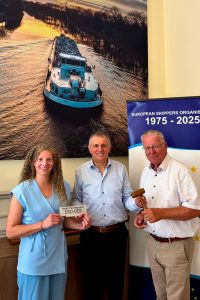
ESO celebrates its 50 years anniversary

Brussels, June 2025. The European Skippers Organisation ESO is proud to announce the celebration of its 50th anniversary, a milestone marking 5 decades of supporting and representing the inland navigation in Europe.
Monday, 22 September we gather at Martinushoeve, Zandvliet (near Antwerp) from 10:30 to approx. 15:00 hrs.

To commemorate this occasion we warmly invite you to join us for the special event of our 50
th anniversary, which has been themed:

Entrepreneurship, the backbone of our industry: now and in the future
and
Circular Mobility, the cargo of the future?

We will bring together some interesting speakers and panelists to discuss the future of our industry.

Past and future
This anniversary will reflect on the achievements in the past period. But even more important, where is our industry heading to? As sustainable transport mode the future looks promising, but also challenging with the ever changing (manning) regulations, cargo flows and continuing pressure on entrepreneurship.

A lunch is foreseen permitting a relaxed environment to meet and discuss with each other.

After finalising the program a formal invitation with further details will be presented. Please mark your calendar and join us celebrating our 50th anniversary. We look forward meeting you.

Warm regards,

Christiaan van Lancker, President of ESO-OEB vzw                                                     Read the full press release here.
b/o Erik Schultz (on behalf of the Organizing committee)

Europe requires a stronger EU transport budget

Europe’s transport sector is the backbone of the EU internal market and outreach to the world.
A strong sector is a prerequisite for building a competitive, net-zero
and resilient Europe.

Open letter to Member States and Commission

Brussels, February 5th, 2025. Europe’s transport sector strongly urges the Member States and the Commission to preserve and strengthen a solid dedicated European transport funding instrument under the future EU budget. The European coordination of infrastructure across Europe is more than ever crucial. It is the only guarantee for safeguarding the smooth functioning of the EU internal market, promoting Europe’s competitiveness and cohesion, and bolstering its resilience and military preparedness.
45 European transport organisations have joined forces and are collectively urging national governments and the European Commission to maintain and strengthen a robust dedicated European transport funding instrument under the future EU budget.

Strategic importance
The transport sector is as such very concerned about the Commission’s plans to redirect a large majority of the European transport funding towards National Single Plans and asks the General Affairs and Finance Ministers of the Member States to give a strong signal towards the Commission in favour of preserving a solid dedicated European transport funding instrument.
In fact, a robust European transport network is of strategic importance in responding to Europe’s current challenges. With rising geopolitical tensions and ongoing climate change, it must be Europe’s top priority to strengthen and adapt our infrastructure, address bottlenecks and missing links, and optimise its connectivity and capacity.

Dedicated European transport funding instrument
The transport sector therefore urges the Member States and the Commission to choose for an approach that strengthens Europe, to preserve a strong and centrally coordinated dedicated European transport funding instrument that prioritises investments of high European added value, and to refrain from jeopardising the future and competitiveness of Europe’s transport network, which is fundamental to achieve Europe’s priorities.

The full text of the open letter  to the EU Member States, with the full list of signatories, can be found here.

Inland Water Transport indispensable to Europe

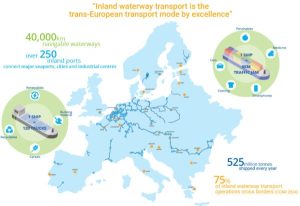
Brussels, December 2024. The Inland Waterway Transport and Ports sector plays a critical role in sustaining Europe’s economic vitality and its climate and environmental goals. Inland waterway transport is serving major industries across Europe. It provides reliable and efficient transport solutions for heavy industries, consumer goods, urban deliveries, construction and more.

A robust inland waterway ecosystem is essential to fostering industrial and commercial success, supporting and attracting industries critical to European prosperity and resilience. The Inland Waterway Transport and Ports sector urges policymakers, industries, and citizens to recognise the unique value of inland waterway transport. Together, we can ensure its role in a competitive, sustainable and resilient Europe.
Robust and resilient infrastructure needed
It is important to note that creating a well-functioning transport network goes beyond addressing megaprojects. The Connecting Europe Facility is currently the best tool to realise the TEN-T and ensure that European industries continue to have a strong logistical backbone upon which to rely  for the coming century.
‘However, the sector’s ability to deliver to its full potential hinges on robust and resilient infrastructure, especially in the face of increasing challenges like low water levels and the impacts of climate change. We will need an adequate and dedicated budget line, capable of removing all bottlenecks affecting cross-border connectivity. A centrally managed budget would provide the stability and focus needed to build a resilient future for the sector and the continent.’ concludes Christiaan Van Lancker, President, European IWT Platform and ESO.

Read the full press release

ESO’s annual report 2023

Writing a foreword for the annual report of the EUROPEAN SKIPPER’S ORGANISATION (ESO) VzW is and remains a great challenge for me as president. I am therefore very proud to be able to present this report to you again for the 2023 working year!
And speaking of challenges! The European inland shipping sector – and more specifically our independent inland skippers/inland shipping entrepreneurs – also face extremely challenging issues in the coming years!

Without the ambition to be complete, I will nevertheless venture a brief summary: energy transition, greening, (new) crew regulation, staff shortages, automation, digitalization, etc., etc.
Every company – even outside our sector – is confronted with this today!

More in the macro-economic sphere, I should certainly add the aspect of “modal shift” as far as inland shipping is concerned. The necessary attention to our ecological environment is of course of (over) vital importance. However, in my opinion, this should be accompanied by healthy, pragmatic economic growth and incentives. ESO will work tirelessly to achieve this!
It makes me hopeful that, from my daily practice as an accountant, I can conclude that our (European) supporters are increasingly delving into each of these issues. In this regard, a very strong awareness process has been initiated!

ESO 50 years
The ESO, founded in 1975, will celebrate its 50th anniversary next year. The necessary preparations for this are taking more concrete forms! You will be further informed about this in due course. This event is also a unique and fantastic challenge for our directors and myself. Perhaps this will also be a pivotal moment for many of us! We are looking forward to it!

I hereby invite you to read the more detailed explanation in this annual report, with thanks to our esteemed Secretary General Gerard Kester, and to carefully read his critical view on each of these topics.

Christiaan Van Lancker
president

Find the complete foreword and annual report (english/dutch) via this link.

Plenary session CCNR Autumn 2024

On 5 December 2024, the Central Commission for the Navigation of the Rhine (CCNR) held its autumn plenary session. The meeting was chaired by Mr Michiel van Kruiningen, head of the Dutch delegation.
At the plenary meeting, a number of resolutions were adopted, relating to stretches designated as presenting specific risks, the economic situation of inland navigation in Europe, police regulations, technical requirements for vessels and matters concerning the Rhine waterway.

Slight economic improvement
During the first half of 2024, the global economy showed signs of improvement. Inflation fell and, by 2025, is expected to reach 2% in developed economies. However, trade is experiencing more difficulties, with its recovery hampered by numerous trade barriers, and geopolitical crises and wars.
Thus, a slight fall in freight transport was observed for the Rhine (-1.5%*) and almost all the Rhine States during the first half of 2024.

Less paper
Some amendments to the Police regulations for the navigation of the Rhine (RPR) were also adopted.
As a result, certain certificates and other on-board documents relating to the transport of dangerous goods will now be authorised in electronic form on board inland waterway vessels. This amendment ensures consistency between two legal frameworks: the RPR and the ADN Regulatio (2025 edition).
Paperless documents also reduce the administrative burden on the profession.
The amendment will come into force on 1 December 2025.

Click for the the complete press release the links                  


ESO presents annual report 2018

Foreword ESO’s annual report 2018

Dear reader,

In my capacity as president of the European Skippers’Organisation (ESO) vzw it is truly an honor and pleasure to introduce to you our annual report on the 2018 working year.

Although ESO was already founded in 1975, now that legal entity has recently been acquired, this annual report gives us an opportunity to present to you an insight into the activities with which our skippers’ organisation is involved, naturally with the focus on Europe, the CCNR and other supra-national bodies.

With some sense of pride, I can state without a shadow of a doubt that with modest means, but with an international group of enthusiastic employees, we uphold the interests of inland shipping. In particular we attend to the interests of the independent entrepreneurs / skippers, almost in all its facets.
This is by no means an easy task and, as you can see in this report, a solid internal organisation has been set up.

The external structure has also been put on the European map since the end of 2017 with the establishment of the joint IWT platform (Inland Waterway Transport). In a joint composition with the European Barge Union (EBU), we focus with this platform on the enormous challenges facing the inland shipping sector in Europe.

I would like to take this opportunity to honor our former Secretary-General, Hester Duursema – who left us in 2018- for the groundbreaking work she has achieved in her relatively short stay with ESO!

I sincerely wish to thank all employees in front of and behind the scenes of ESO from the bottom of my heart for their disinterested, but very professional attitude and infectious workforce. Since 2012 I am allowed to be part of this excellent team.

PANTA RHEI… .. everything flows…. everything is moving …

Yours sincerely,                                      

Christiaan VanLancker, president.

Link to the annual report

CESNI publications and work program

Press release CESNI                                                                               

Strasbourg, 10 April 2019 – The European Committee for drawing up Standards in the field of Inland Navigation (CESNI) met in Strasbourg on Wednesday 10 April 2019. The meeting was chaired by Ms Lucia Luijten, representing the Netherlands.

11 Member States (Austria, Belgium, Czech Republic, France, Germany, Netherlands, Poland, Romania, Slovakia, Switzerland, United Kingdom), as well as the European Commission, the River Commissions (Moselle, Rhine) and 7 organisations approved by CESNI (Aquapol, EBU, EDINNA, ESO, ETF, GERC, IVR) participated in the meeting of the Committee.

The discussed items are published in the Committee’s press release:            

  • New publications and updates in the field of technical requirements for vessels
  • Debates on uniform models for certificates of qualification
  • Request for approval from the “European Maritime Heritage” (EMH) association
  • Work programme 2019-2021

ES-TRIN 2019 Standard adopted by CESNI

Solutions for difficult transitional measures have been incorporated in ES-TRIN 2019!

Brussels, 13 November 2018 – Press release ESO and EBU.                                
The CESNI-Committee has adopted on 8 November 2019 the new ‘European Standard laying down Technical Requirements for Inland Navigation vessels’, ES-TRIN 2019, replacing ES-TRIN 2017. The solutions for difficult transitional measures are incorporated.

EBU und ESO associated in the “ European Inland Waterway Platform ( shortly IWT Platform)“ have fully participated in the negotiations to make sure that the interests of the inland waterway transport sector will be taken into account as far as possible. The common efforts are now clearly yielding fruit!

Solutions for difficult transitional measures
It takes long to formulate new regulations and if necessary even longer to change the regulations. Detailed studies, extensive deliberations and many years of intense engagement of the inland
waterway transport sector have resulted in a solution for difficult transitional measures. They refer to noise protection, models for electrical equipment and installations, ship’s boats, escape routes and propulsion systems for passenger vessels, all serious bottlenecks for the inland waterway transport sector. EBU and ESO are pleased that with ES-TRIN 2019 solutions in the interest of the inland waterway transport sector were found.

ES-TRIN 2019
In order to guarantee a high level of safety of the transport on inland waterways and at the same time considering the technological developments, the European Standard laying down Technical Requirements for Inland Navigation vessels (ES-TRIN) is subject to a regular revision. ES-TRIN on itself is not binding.
The Central Commission for the Navigation on the Rhine and the European Union will refer to it in their statutory framework, as with currently applicable Standard ES-TRIN 2017.
ES-TRIN 2019 will enter into force on 1 January 2020.

Downloadlinks for the complete document:

(Think before printing, document counts over 500 pages.)

NL – CESNI ES-TRIN 18_15 nl
EN – CESNI ES-TRIN 18_15 en
DE – CESNI ES-TRIN 18_15 de
FR – CESNI ES-TRIN 18_15 fr

ESO launches Barging Terms & Charterparty

ESO Inland Barging Terms & Charterparty version 1
Developed by ESO’s Commission for Tanker Shipping and ADN               pdf-versions      

Brussels, May 3rd, 2018. This day the ESO Inland Barging Terms & Charterparty were launched at the 4th European Oil Barge Conference, organised by ASDEM Ltd in Rotterdam. A step forward in the professionalisation of the inland tanker shipping sector.
The inland tanker shipping needed its own terms and charterparty just as any other professional sector. Therefore back in 2017 ESO started developing these.with a group of experts and members.

              .

Mr. Co Abercrombie (director BLN-Schuttevaer) presenting Barging Terms & Charterparty

The development of the ESO Inland Barging Terms & Charterparty was done from the viewpoint of the shipowner/actual carrier. Striving for consensus as well as creating a document which can be used for negotiation, the ESO Inland Barging Terms & Charterparty form the basis for this. These terms can be seen as a modernisation of the current TTB-conditions or other common terms which are used today.

As a European branch organisation which defends the interests of the private inland shipping entrepreneurs, ESO took its responsibility to form basic terms and a charterparty which strengthens the position of the individual shipowner/actual carrier, active in the inland tanker shipping sector. Meanwhile ESO continues to support the entrepreneurs and create a modern and professional sector, in consensus with all parties involved.

You can download the ESO Inland Barging Terms & Charterparty here: Barging Terms & Charterparty.

At this moment the document is only available in the english language.